
Top 3 Reasons Why Epoxy Beats Granite and Quartz Countertops
By Dereck — Owner, All Surface Epoxy | Menahga, MN | 25 years in the trades
Why is epoxy a smarter choice than granite or quartz countertops? Three reasons, and they all matter on the same kitchen project: epoxy typically comes in well below the cost of quartz or granite in this area, it is fully customizable to your colors and design rather than limited to what is in stock at the stone yard, and the way we build it — in a controlled shop environment, not on a tarp in your kitchen — produces a finish you simply cannot get from a slab supplier and an installer driving in for the day.
That is the short version. Below is the long version, written by a craftsman who has spent 25 years in the trades — 5 in residential construction, 20 in concrete and surface craft — and now builds custom epoxy countertops in a proper shop in Menahga, MN for homeowners across Lakes Country, the Red River Valley, and the lake communities in between.
QUICK ANSWER: Epoxy countertops beat granite and quartz on three measurable axes: (1) lower cost — most epoxy projects come in well below the price of comparable quartz or granite in the MN/ND area; (2) full customization — you choose the exact colors, veining, and finish rather than picking from in-stock slabs; (3) shop-built quality — custom epoxy counters are fabricated in a climate-controlled shop and installed finished, eliminating dust contamination and template-cut seams. Granite or quartz may still be the right choice if you want a natural-stone provenance, the highest possible heat resistance, or a thicker-edge profile.
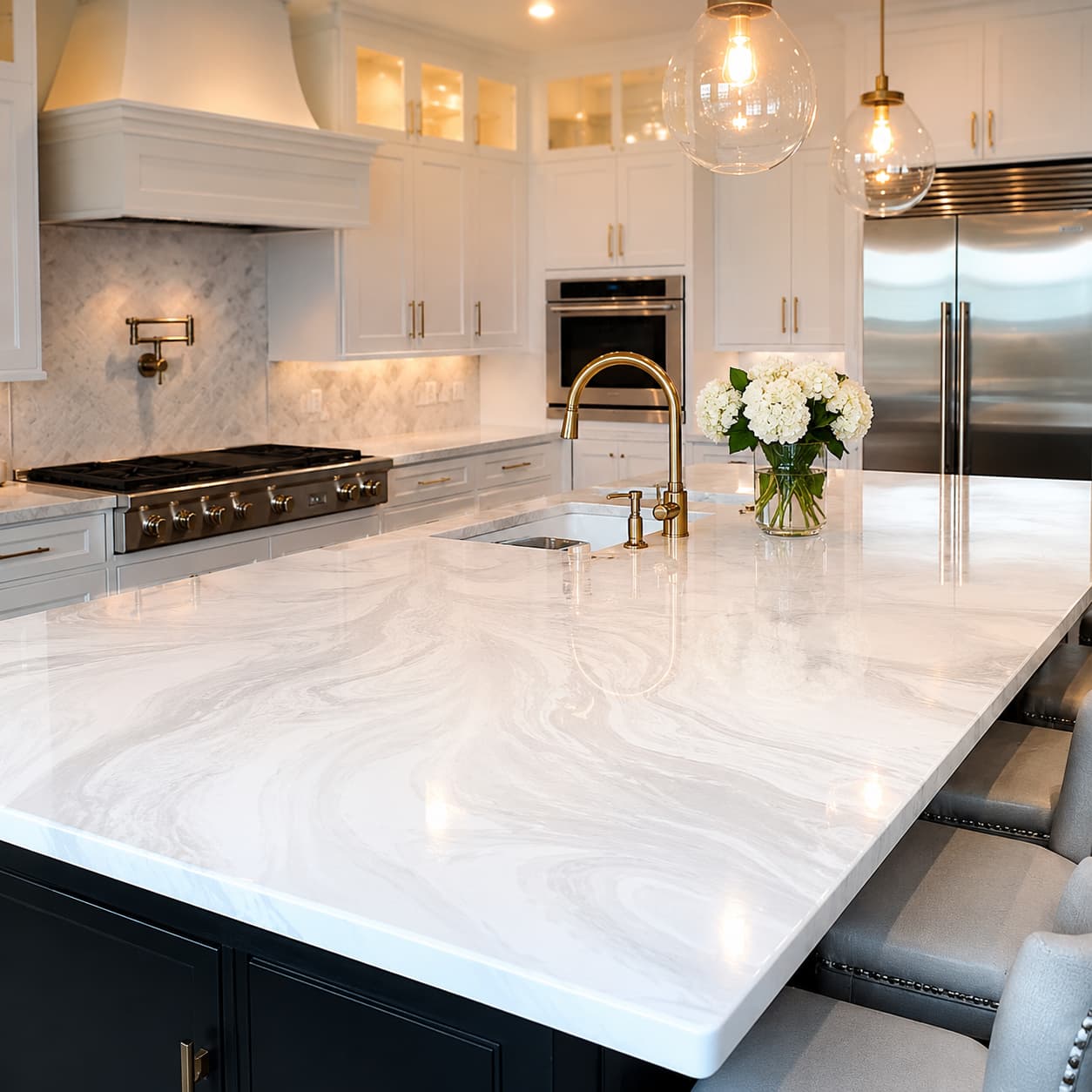
First, a quick honesty check on stone countertops
Quartz and granite are good materials. We are not here to bad-mouth them. They look beautiful, they hold up well, and millions of homeowners are perfectly happy with them. If you have a deep budget, a love of natural stone, and a kitchen with a layout that works in slab geometry, granite or quartz can be a fine call.
But "fine" is a low bar when you are about to spend $10,000–$20,000 on a kitchen surface that will be in your home for 20 years. The question is not whether granite and quartz are acceptable. The question is whether they are the smartest, most practical choice for your kitchen, your budget, and how you actually use your space. For most homeowners we talk to across Minnesota and North Dakota, the answer is increasingly no — because of the three reasons below.
Reason 1: Epoxy typically costs well below granite or quartz in this region
Walk into a kitchen-and-bath showroom in Fargo, Brainerd, or the Twin Cities and price out a nice quartz kitchen and you will see numbers in the $8,000–$15,000 range installed. A high-end granite job can cross $20,000 once you factor in slab cost, fabrication, seam joints, sealing, and installation. The materials themselves are expensive, the slabs have to be quarried or manufactured and shipped in, and the labor to template, cut, and install them is specialized.
A custom-built epoxy countertop — same dramatic look, same daily-use durability — most often comes in well below the cost of a quartz or granite installation in this area, depending on size and finish. You get the marble or onyx aesthetic without the marble or onyx invoice.
Why epoxy costs less without compromising the result
A few specific reasons the math works out the way it does:
•No quarry, no slab freight. Granite has to be quarried in Brazil, India, or Italy, cut to size, and shipped. That logistics chain is in your final price. Epoxy is manufactured chemistry that ships in much smaller volume.
•No second-fabricator markup. Most granite and quartz jobs run through a fabricator who marks up the slab, then an installer who marks up the labor. With our shop-built process, the craftsman who quotes the job is the one who builds and installs it. One set of hands, one price.
•No demo in most cases. Quartz and granite installations require removing your existing countertops and disposing of them. With epoxy, in many cases we can build directly over a sound existing substrate, which saves on demolition and disposal fees.
•No annual maintenance cost. Granite needs to be sealed roughly every year to stay non-porous. That cost is small per year, but it adds up over a 20-year ownership window. Epoxy is non-porous from the start — no annual seal required.
All of that adds up to a kitchen that looks like a magazine spread for substantially less money. We provide a written, itemized quote before any work starts, so you can see exactly where every dollar goes and compare it side-by-side with the granite or quartz bids you have already collected.
Reason 2: Epoxy is fully customizable. Granite and quartz are not.
When you buy granite, you are buying a slab. The slab was quarried in one piece from a specific stone formation, and what you see is what you get. The veining is whatever the earth produced. The color is whatever that particular slab contains. If you want a different pattern, you pick a different slab — from whatever is in stock at your local stone yard on the day you are shopping.
Quartz gives you a little more design flexibility because it is engineered, but you are still picking from a manufacturer’s catalog of pre-set patterns. There are dozens of options, but they are still options on a list. The pattern in your kitchen is also the pattern in thousands of other kitchens.
Custom epoxy is a different animal. Every countertop we build is hand-mixed and hand-poured to your specific design. You are not picking from a catalog. You are co-designing a one-of-one piece for your kitchen.
What "fully customizable" actually means in practice
•Match your exact color palette. Bring a paint chip, a cabinet sample, a backsplash tile, or a fabric swatch. We custom-mix every pour to your colors — not the closest option on a sample card.
•Choose the veining and pattern. Soft fog-and-birch marble. Dramatic black-and-gold metallic. Driftwood-toned travertine. Charcoal with rust-orange flecks for a cabin kitchen. Whatever you can sketch or pin to a board, we can build.
•Pick the finish. Matte for a soft modern read. Satin for the middle ground that wipes easy. Polished for a wet-stone look. Your choice, not ours.
•Seamless across long runs. Granite and quartz have visible seams every time you cross a slab boundary — typically every 8–10 feet on an L-shaped kitchen. A custom-built epoxy counter can run seamlessly across the entire kitchen with no visible joints.
•Unusual shapes are not a problem. Curved islands, integrated drainboards, custom waterfall edges, blended-in sinks. With slab stone you fight the geometry. With epoxy, we build to the geometry.
Customers in lake-cabin kitchens use this differently than customers in modern Fargo or Moorhead remodels. The cabin owner often wants a finish that feels organic and tied to the lake setting — muted earth tones, soft veining, satin finish. The Fargo professional often wants high-contrast metallic veining and a polished finish that reads urban. Both are achievable. Neither is on a quartz sample wall.
Reason 3: Shop-built epoxy is a higher-quality finish than any on-site installation
This reason is the one most homeowners do not know to ask about, and it is the one that separates a good epoxy job from a great one.
Most epoxy installers in this region pour your countertop on a tarp directly in your kitchen. Dust from your subfloor renovation drifts through the air. Pet hair lands in the wet resin. The temperature in your kitchen fluctuates as the door opens and closes. The lighting is whatever you have over your sink. Whatever is in the air — dust, fibers, moisture variation — ends up in the cured finish. The result is acceptable, but it is not flawless. And once it is cured, it is cured. You cannot undo what got embedded in the surface.
We do not work that way.
What "shop-built" actually means
Every custom countertop we build is fabricated in our controlled shop environment in Menahga, MN — climate-regulated, dust-free, and lit specifically for finish work. The shop is set up the way a fine furniture shop or an automotive paint booth is set up: every variable that affects the final surface is controlled by the person building it.
We measure your kitchen. We bring sample boards so you hold the actual finish in your hand before you decide. We build the countertop in the shop — mix, pour, cure, polish, finish. Then we deliver the finished piece to your home and install it in a day, sometimes two. You do not live with the mess. You do not live with the dust. You do not have a contractor mixing chemistry in your kitchen for two weeks. You get a flawless finish and a clean kitchen.
Why this matters more than it sounds like it should
•No contamination in the finish. Dust, pet hair, airborne particles, moisture variation — none of it gets near the wet epoxy. The surface comes out the way it was designed to come out.
•Consistent cure temperature. Epoxy chemistry is temperature-sensitive. A cold kitchen at 6 a.m. and a warm kitchen at 2 p.m. cure the resin differently. The shop holds temperature constant, which produces a more uniform finish.
•Proper lighting for the work. Finish work needs raking light to reveal imperfections during pouring and polishing. Your kitchen ceiling fixtures were not designed for that. Our shop lighting was.
•Compressed timeline at your home. Most kitchens are functional again within 1–3 days of install. An on-site pour can keep your kitchen out of service for a week or more while the resin cures in place.
•You see the finished product before it comes into your home. Because the piece is built in the shop, you can come look at it before installation. Granite slabs you choose at a yard — but you cannot see the finished counter until it is bolted to your cabinets.
Granite and quartz installations are inherently on-site — the slabs are cut to template in a fabrication shop, but they are installed in your kitchen, with seam joints made on the day of installation. The shop-built epoxy approach takes the entire finish work out of your kitchen, which is a quality advantage you simply cannot replicate with slab stone.
When granite or quartz might still be the right call
Honest answer from a craftsman who could just keep selling: there are situations where stone is genuinely the better choice.
Granite or quartz is the right call if:
•You specifically want a natural-stone provenance. Some homeowners want the slab to be a real piece of geology, quarried from a specific place. Epoxy cannot fake that, and it would be silly to try.
•You set unprotected cast iron straight from a 500°F+ burner directly on the counter. Quartz tolerates up to about 300–50°F and granite is essentially heat-proof. Epoxy is heat-resistant to about 425°F — plenty for normal kitchen use, but stone wins in extreme thermal situations.
•You want a 2-inch-thick mitered edge profile. A truly thick natural stone edge is dramatic and stone-specific. Epoxy can do thicker edges, but the very heaviest aesthetic belongs to slab.
•You already have an existing quartz or granite counter you love. Do not tear it out to switch materials. Maintain what you have.
For everyone else — which is most homeowners we work with across MN and ND — epoxy is the smarter, more practical, more customizable choice for substantially less money.
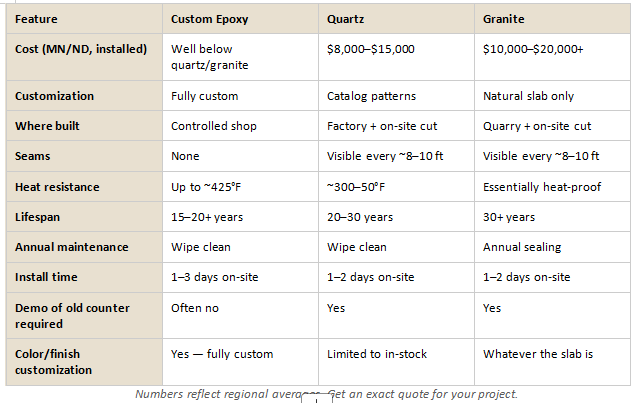
Epoxy vs. granite vs. quartz: side-by-side comparison
At-a-glance comparison of the categories homeowners care about most. Numbers are regional averages for Minnesota and North Dakota:
Why this matters specifically in Minnesota and North Dakota
A few regional factors make the epoxy case stronger in this part of the country than it might be elsewhere:
•Long winters mean kitchens get heavy use. Five months of indoor cooking, baking, and entertaining puts hard miles on a kitchen surface. The non-porous, non-staining nature of epoxy holds up beautifully under high-use conditions.
•Many homes have non-standard layouts. Older farmhouses, lake cabins, and remodeled hunting properties often have kitchen geometry that does not template well to slab stone. Epoxy builds to the geometry.
•Hard water everywhere. Most well water in MN lake country and the Red River Valley has high mineral content. Granite needs to be sealed against it; epoxy does not.
•Cabin kitchens want a specific look. Lake-country and Northwoods kitchens often want finishes that feel tied to the setting — muted earth tones, soft veining, organic patterns. Epoxy lets you build that exactly. The stone yards have what they have.
All Surface Epoxy builds custom countertops for homeowners across Detroit Lakes, Fargo–Moorhead, Alexandria, Bemidji, Brainerd, and the surrounding Minnesota and North Dakota communities. Our shop is in Menahga, MN, and we travel across MN and ND for larger projects.